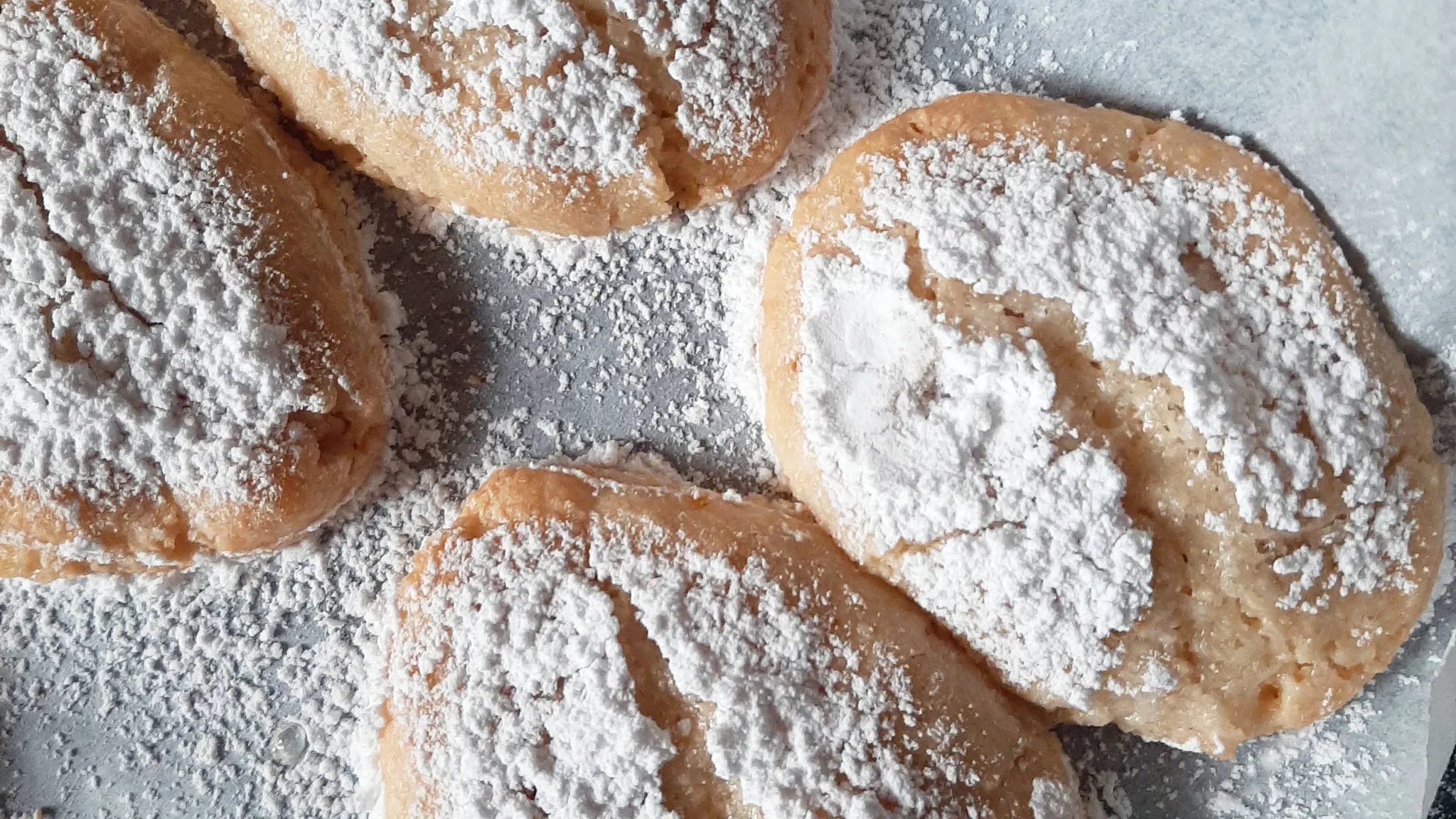
Imagine strolling through the narrow streets of Siena at sunset, with the air filled with toasted aromas: that is where the scent of ricciarelli is born, those iconic little biscuits that are slightly crisp on the outside before melting into a soft almond-flavored heart, wrapped in a veil of powdered sugar and orange zest.
These traditional sweets are a cornerstone of Tuscan pastry-making, protected by the Sienese PGI status and rooted in centuries of artisanal mastery. One bite takes you back to the heart of the Renaissance, when nobles and nuns transformed humble ingredients into courtly jewels.
Today we will learn how to prepare them following the recipe of our Cesarina Silvia from Abbadia San Salvatore. Silvia, guardian of secrets handed down through generations, guides us step by step through her family version, enriched with her mountain touch.
"My grandmother was from Siena; she used to place a small piece of wafer under each ricciarello so they wouldn’t stick to your hands and especially not to the baking tray – at the time baking paper didn’t yet exist. I continue her tradition to keep that unique homemade flavor alive".
A bite of history
The history of Ricciarelli dates back to the Middle Ages and intertwines with the tradition of marzipan, a sweet likely brought to Siena from the East. The current name, “Ricciarello,” is linked to a charming legend. It is said that the Sienese knight Ricciardetto della Gherardesca, returning from the Crusades in the Holy Land, brought back the idea of Eastern almond-based sweets.
These resembled the shape of babouches (the typical curled slippers of sultans), from which the name ricciarelli (“little curled ones”) is believed to derive.
In more recent times, these sweets were called in local gastronomy “marzapanetti alla senese,” a name that highlights their origin from marzipan, which at the time was widespread in convents and workshops.
In March 2010, Ricciarelli di Siena obtained the Protected Geographical Indication (PGI), becoming the first Italian baked confectionery product to receive such protection from the European Union. Today, to bear the PGI label, Ricciarelli must be produced exclusively in the province of Siena.

Ricciarelli senesi
Marzipan cookies typical of Tuscan tradition
DifficultyMedium
Preparation time1h
Cooking time18m
€
CostMedium
Ingredients
- 200 g almond flour
2 egg whites at room temperature
200 g powdered sugar (+ 100 g for finishing)
Finely grated zest of 1 orange
1 teaspoon lemon juice
Method
- Whisk the egg whites together with the grated orange zest and lemon juice until lightly frothy.
- Add the almond flour (you can make it by blending already blanched almonds) and the powdered sugar.
- Mix with a spoon until you obtain a smooth, compact dough similar to a small loaf, then wrap it in plastic wrap.
- Let it rest in the refrigerator for between 24 and 36 hours.
- After resting, take portions of dough about the size of a tablespoon and shape them into small cylinders.
- Flatten them with the palm of your hand to a thickness of about 1 cm and pinch the ends to create the typical grain shape.
- Place the ricciarelli on a baking tray lined with baking paper, spacing them about 5 cm apart.
- With a brush, lightly moisten the surface and dust with powdered sugar.
- Bake in a preheated oven, on the middle rack, at 150°C for 5 minutes.
- Then raise the temperature to 170°C and bake for 5–6 minutes.
- Finally lower it to 160°C and continue baking for another 5–6 minutes.
- Once baked, transfer them to a wire rack and let them cool completely.
- Attention: remove them from the oven with a spatula and handle them very gently, as they are still very soft when hot.
Sweet Tooth
Homemade tarts, mousses, tiramisu, regional cakes, biscuits and much more! Do you want to have fun and pamper yourself with taste because you can't resist sweet treats? Discover Cesarine's experiences and treat yourself to a moment of pure sweetness to make your day unforgettable!
5 (133)
Cooking Classes
Baked Cooking: From Sweet to Savory!Hosted by Aurora
Verona
€111 per guest
Shared Experience
5 (1)
Cooking Classes
Sweet Campania: the Annurca Apple Pasticciotto!Hosted by Patrizia
Sant'Agata de' Goti
€62 per guest
Shared Experience
5 (30)
Cooking Classes
Cooking class on fresh pasta and traditional dessertHosted by Fabiana e Andrea
Asti
€72 per guest
Shared Experience
Cooking Classes
Cooking Class:Typical Venetian Flavors & Traditional DessertHosted by Gabriella
Ponte di Piave
€123 per guest
Shared Experience